
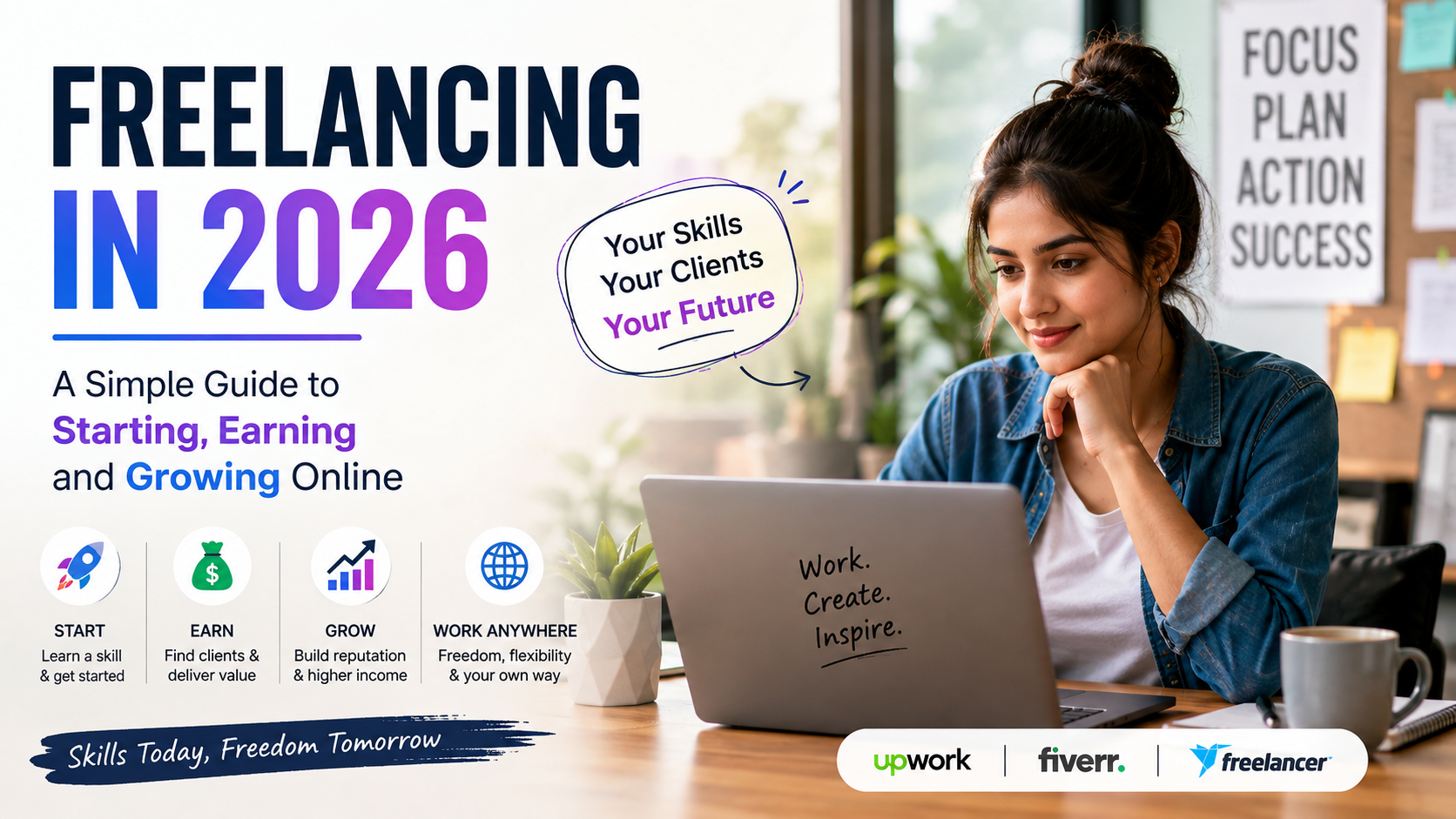
Freelancing has become one of the most popular ways to work online. Instead of working permanently for one company, a freelancer provides their skills to different clients and gets paid for individual projects or contracts.
In 2026, freelancing is no longer limited to writers and graphic designers. People are earning through web development, digital marketing, SEO, video editing, social media management, content creation, AI services, data analysis, UI/UX design and many other skills.
The opportunity is real, but freelancing is not a shortcut to easy money. You need a useful skill, good communication, patience and the ability to find and retain clients.
What Exactly Is Freelancing?
Freelancing simply means working independently for clients instead of being a permanent employee of one company.
For example, imagine that a local restaurant needs a website. Instead of hiring a full-time developer, the restaurant can hire a freelancer to create the website for ₹10,000.
After completing the project, the freelancer gets paid and can work with another client.
A freelancer can work:
- Full-time
- Part-time
- Alongside college
- Alongside a regular job
- From home or almost anywhere with an internet connection
This flexibility is one of the biggest reasons people choose freelancing.
How Big Is Freelancing in 2026?
The freelance economy continues to grow, although the numbers vary depending on how "freelancer" and "gig worker" are defined.
According to Upwork's 2026 research, 39% of U.S. workers freelance, an increase from the previous year. Upwork also reports that around 38% of skilled knowledge workers currently operate independently.
India is also seeing strong growth in flexible and gig-based work. The CII-ETS India Skills Report 2026 estimates that India has around 12–15 million freelance workers, with the broader gig workforce projected to reach approximately 23.5 million by 2030.
However, freelancing does not automatically mean high income. India's Economic Survey 2025–26 highlighted income instability among gig workers, with around 40% earning below ₹15,000 per month.
So, the important lesson is simple:
The market is growing, but your income depends heavily on your skill, positioning, clients and ability to deliver results.
Why Are People Choosing Freelancing?
There are several reasons why freelancing is attractive, especially for students and young professionals.
1. You Can Start Part-Time
You don't necessarily need to quit your job or college.
A student can spend a few hours every day learning a skill and working on small projects.
2. You Can Work With Global Clients
The internet allows a freelancer in India to work with clients from countries such as the United States, UK, Canada, Australia and many others.
Platforms such as Upwork and Fiverr make it possible to find clients outside your local area.
3. You Can Build Your Own Career
Instead of depending completely on one employer, you can gradually build:
Skill → Portfolio → Clients → Reputation → Higher Rates
Over time, freelancing can even become a small agency or business.
4. You Can Choose Your Services
A freelancer can specialize in one service or combine several related skills.
For example:
Digital Marketing Freelancer
- SEO
- Social media management
- Content writing
- Google Business Profile optimization
- Meta Ads
- Local business marketing
This combination can be especially useful for small businesses.
Which Skills Can You Freelance in 2026?
Freelancing has expanded far beyond traditional writing and graphic design.
Some popular areas include:
| Skill | Example Freelance Work |
|---|---|
| Web Development | Websites, landing pages, web apps |
| SEO | Keyword research, technical SEO, local SEO |
| Digital Marketing | Campaigns, strategy, lead generation |
| Social Media | Instagram/Facebook management |
| Graphic Design | Posters, social media creatives, branding |
| Video Editing | Reels, YouTube videos, advertisements |
| Content Writing | Blogs, website content, product descriptions |
| AI Services | AI automation, AI-assisted content, workflows |
| UI/UX Design | Website and app interfaces |
| Programming | Software, APIs, automation |
| Data Analysis | Reports, dashboards and data processing |
The important thing is not to learn everything at once.
Choose one primary skill and become useful at it.
Freelancing and AI in 2026
AI has changed freelancing significantly.
A freelancer can now use AI to research ideas, generate drafts, write code, analyze information, create workflows and automate repetitive tasks.
But there is also another side.
Some simple freelance tasks are becoming easier to automate, which means freelancers who only provide basic, repetitive work may face more competition.
At the same time, businesses still need people who can understand their problems, communicate with clients, check AI-generated work and deliver a complete solution.
Recent research on freelance knowledge workers also shows that freelancers are increasingly using generative AI for learning and skill development, while still needing to verify and adapt AI output.
Therefore, the better approach in 2026 is:
Don't compete against AI. Learn how to work with AI.
How Much Can a Freelancer Earn?
There is no fixed salary in freelancing.
One person may earn ₹5,000 per month while another may earn ₹1 lakh or more. Some freelancers may earn nothing for several months when starting.
Your income generally depends on:
Income = Number of clients × Project value × Repeat business
For example, suppose you provide social media management.
If you charge ₹5,000 per month:
- 1 client = ₹5,000
- 5 clients = ₹25,000
- 10 clients = ₹50,000
But getting 10 clients is not easy. You also need to consider the time required to serve them properly.
This is why charging more for valuable work is usually better than simply trying to get more clients.
Where Can You Find Freelance Clients?
There are several ways to find clients.
Freelance Platforms
Popular platforms include:
For example, Upwork currently charges freelancers a service fee ranging from 0% to 15% per contract, depending on the contract.
Direct Outreach
You can also contact businesses directly.
For example, if you provide website development, you can find local businesses with outdated websites and send them a professional message explaining how you could improve their online presence.
This method takes more effort, but you don't have to depend completely on freelance platforms.
Social Media
LinkedIn, Instagram and other social platforms can also help you build a personal brand.
Posting your work regularly can make potential clients discover you without you directly applying for every project.
Portfolio Is More Important Than Saying "I Have Skills"
One common mistake beginners make is creating a profile that says:
"I am a professional web developer."
But there is no evidence of their work.
Clients want to see what you can actually do.
Instead of only saying:
"I know web development."
Show:
- 2–3 websites
- Landing pages
- Before/after improvements
- Case studies
- Results
- Screenshots
- Client testimonials
Even if you don't have paid clients yet, you can create sample projects.
For example, you could create a website for a fictional restaurant and use it as a portfolio project.
How to Start Freelancing as a Beginner
You don't need a complicated plan.
Follow this simple process:
Step 1: Choose One Skill
Don't try to become a web developer, designer, SEO expert and video editor at the same time.
Choose one main skill.
Step 2: Learn the Basics
Use free resources such as:
freeCodeCamp for programming and web development.
Google Skillshop for Google-related digital marketing and advertising education.
HubSpot Academy for marketing, sales and content-related learning.
Step 3: Create Projects
Don't spend six months only watching tutorials.
Learn something → build something → make mistakes → improve it.
Step 4: Build a Portfolio
Create a simple website showing:
- About you
- Services
- Skills
- Projects
- Testimonials
- Contact information
Step 5: Start Finding Clients
Try:
- Freelance platforms
- Local businesses
- Friends and family networks
- Direct email
- WhatsApp business outreach
Step 6: Start With Small Projects
Your first goal should not necessarily be ₹1 lakh.
Your first goal should be:
Get experience → Get a successful project → Get a testimonial → Build credibility.
Once you have proof of your work, increasing your price becomes easier.
Common Freelancing Mistakes
Many beginners make the same mistakes.
Trying to Learn Everything
Learning ten skills at once usually results in being average at all of them.
Working Without a Clear Agreement
Before starting a project, clearly discuss:
- What you will deliver
- Deadline
- Number of revisions
- Payment
- Additional charges
- What happens if the project changes
Charging Too Little
Being a beginner doesn't mean your work should be almost free.
Start reasonably, but gradually increase your pricing as your skills and results improve.
Depending on One Platform
Don't build your entire career around one freelance website.
Build your own portfolio, network and personal brand as well.
Ignoring Communication
A technically skilled freelancer can still lose clients because of poor communication.
Reply professionally, meet deadlines and keep the client updated.
Is Freelancing a Good Career in 2026?
Yes, but it should be viewed realistically.
Freelancing provides flexibility and access to a growing digital market, but income can be inconsistent. The rise of AI is also changing which types of freelance work are valuable.
The strongest freelancers in 2026 are likely to be those who combine technical or creative skills + business understanding + communication + AI tools.
For example:
Instead of simply offering "SEO services,"
you could offer:
"Local SEO and Google Business Profile optimization for restaurants and local businesses."
That's more specific and makes it easier for a client to understand what problem you solve.
Final Thoughts
Freelancing is not about sitting at home and making easy money from the internet.
It is a real form of work.
You have to learn a skill, find clients, communicate with them, deliver quality work, manage deadlines and continuously improve.
The good news is that you don't need to be an expert before starting.
Start small.
Learn one skill → Build projects → Create a portfolio → Find your first client → Deliver good work → Get a testimonial → Improve → Increase your rates.
In 2026, the opportunity is there. But the people who succeed will not simply be those who know how to use AI or freelance platforms. They will be the people who can solve real problems for real clients.